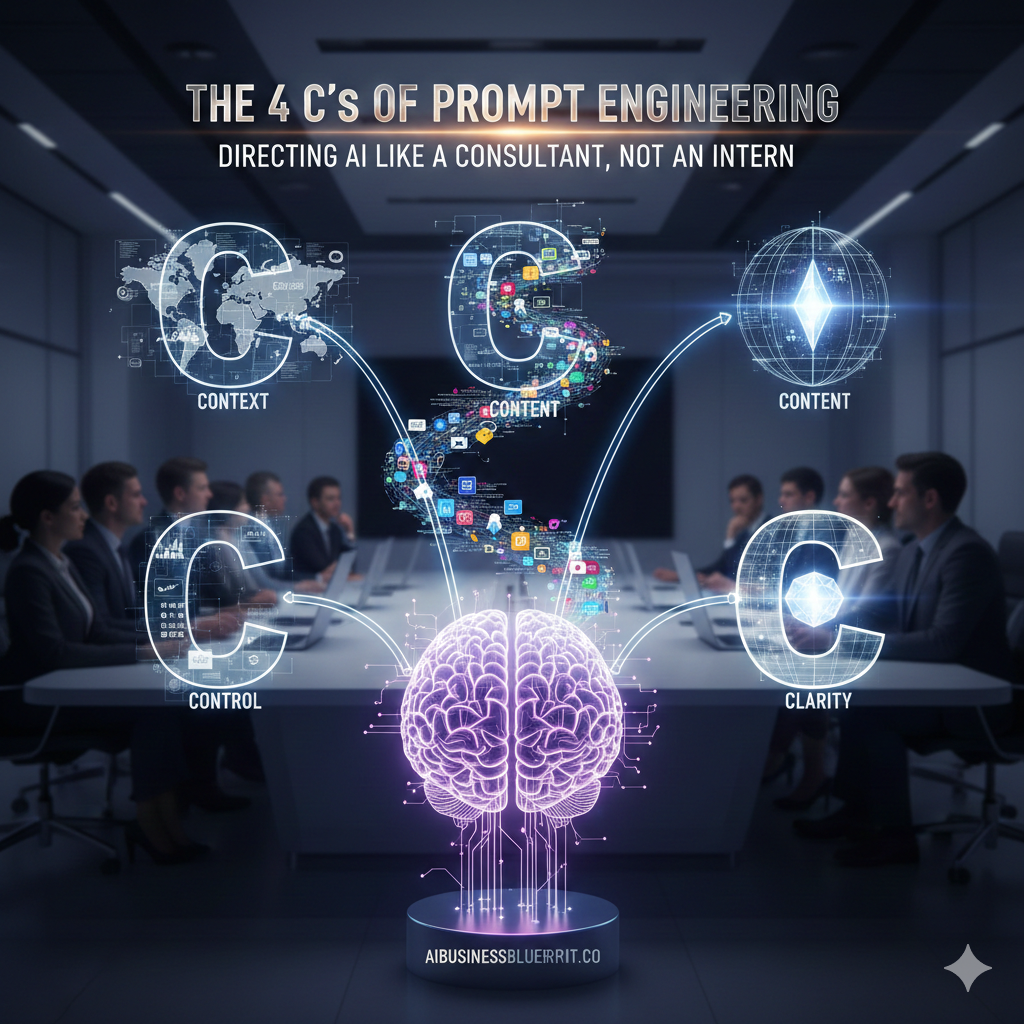
Master the Strategic Framework to Transform Generative AI into Your Most High-Performing Executive Partner
The difference between a business that “experiments” with AI and one that “scales” with AI lies in a single, often misunderstood skill: communication. Most leaders approach Large Language Models (LLMs) like ChatGPT or Claude as if they were magical oracles—dropping a vague sentence and hoping for a masterpiece. When the result is mediocre, they blame the tool.
However, the elite 1% of digital-first leaders—the profiles we study at The AI-Driven Busines —understand a fundamental truth: AI doesn’t fail you; your instructions do. To move from getting “intern-level” drafts to “senior consultant” strategies, you must master the 4 C’s of Prompt Engineering.
What is Prompt Engineering in a Business Context?
Prompt engineering is the strategic process of refining inputs to Generative AI models to ensure outputs are accurate, contextually relevant, and aligned with professional standards. For leaders, it means moving beyond simple chat commands to structured frameworks that treat AI as a high-level consultant rather than a basic digital assistant.
1. Context: Setting the Corporate Stage
The most common mistake in AI interaction is the “Vacuum Prompt”—asking a question with zero background. An intern doesn’t know your company’s mission, your current Q4 goals, or your brand voice unless you tell them. AI is the same.
Context provides the “Why” and the “Who.” Without it, the AI defaults to “average internet person” mode.
How to apply Context:
- Define the Persona: Don’t just ask for a marketing plan. Tell the AI: “You are a Senior Fractional CMO with 20 years of experience in B2B SaaS.”
- Define the Audience: Who is this for? “This report is for a Board of Directors who value brevity and EBITDA growth.”
- The Business Environment: Mention specific constraints. Is the market saturated? Are you in a “Lean Innovation” phase?
In our comprehensive guide, The AI-Driven Business, we emphasize that automation without context is just faster chaos. Your prompts must reflect the strategic depth of a seasoned executive to get results that actually move the needle on your KPIs.
2. Content: The Raw Material of Intelligence
If Context is the stage, Content is the script. This refers to the specific data, examples, or reference points you provide the AI to work with.
Directing the “Consultant”:
Instead of saying “Write a follow-up email,” try providing the Content: “Based on these three bullet points from our last meeting [Insert Points], write a follow-up email that addresses the prospect’s concern about implementation speed.”
Using the “Few-Shot Prompting” technique—providing 2 or 3 examples of what a “good” output looks like—dramatically increases the quality. If you want the AI to write like you, paste two of your previous articles as “Content” references. This ensures the AI isn’t guessing; it’s replicating excellence.
3. Control: Establishing the Guardrails
A junior intern often wanders off-task or uses a tone that doesn’t fit the brand. A consultant follows a methodology. Control is about setting the parameters of the output.
“But, how do I control AI output quality in business?” You control AI output by defining specific constraints such as word count, tone of voice (e.g., “authoritative yet empathetic”), formatting (e.g., “use Markdown tables”), and negative constraints (e.g., “do not use corporate jargon or buzzwords like ‘synergy'”).
The “Rules of Engagement”:
- Length: “Keep the summary under 200 words.”
- Format: “Output the final strategy as a SWOT analysis table.”
- Tone: “Use the ‘Executive Leadership’ style—direct, data-backed, and visionary.”
- Exclusions: “Avoid mentioning competitors X and Y.”
By applying strict controls, you eliminate the “hallucination” factor and ensure the AI stays within the strategic boundaries of your Strategic Frameworks.
4. Clarity: The End of Ambiguity
The final “C” is Clarity. This is the elimination of “double-speak.” If a human could interpret your instruction in two ways, the AI definitely will.
Refining for Clarity:
- Sequential Steps: Use “First, do X. Second, analyze Y. Finally, output Z.”
- Specific Verbs: Instead of “Help me with…”, use “Analyze,” “Draft,” “Critique,” or “Summarize.”
- Check for Understanding: A pro tip is to end your prompt with: “Before you begin, do you have any questions about the context or the desired goal?” This forces the AI to act like a consultant who wants to get the job done right the first time.
Moving from Manual Tasks to the “Income Engine”
Mastering these 4 C’s is the first step toward the “Motor de Ingresos Autónomo” (Autonomous Income Engine). When you can prompt effectively, you can automate effectively. You stop being the person doing the work and start being the person supervising the intelligence.
This transition is exactly what we map out in The AI-Driven Business. The eBook serves as the architectural blueprint for leaders who want to stop “playing” with AI and start “deploying” it to protect their legacy and ensure generational success. While prompt engineering handles the communication, the eBook handles the infrastructure.
Comparison: Intern vs. Consultant Prompting
| Feature | The “Intern” Prompt (Low Value) | The “Consultant” Prompt (The 4 C’s) |
| Request | “Write a blog post about AI.” | “Act as an AI Strategy Expert. Write a 1,500-word deep dive into AI implementation for COOs.” |
| Context | None. | “Focus on mid-sized manufacturing firms facing ‘churn’ issues.” |
| Content | General knowledge. | “Incorporate the D.A.T.A. Framework principles: Define, Automate, Track, Augment.” |
| Format | Blocks of text. | “Use H2 headings, bullet points for readability, and a professional tone.” |
| Outcome | Generic, boring, unusable. | Strategic, actionable, and brand-aligned. |
Strategic Implementation: The D.A.T.A. Framework
To truly leverage the 4 C’s, you should integrate them into a broader operational flow. At aibusinesblueprint.co, we recommend the D.A.T.A. Framework:
- Define: Use Clarity and Context to define the task.
- Automate: Use the 4 C’s to create a “Master Prompt” that can be reused.
- Track: Evaluate the AI’s output against your KPIs.
- Augment: Refine the prompt (Control and Content) based on the results to achieve “Precision Absolute.”
Conclusion: Your Evolution as an AI Leader
Directing AI is not a technical skill; it is a leadership skill. By adopting the 4 C’s of Prompt Engineering, you are essentially upgrading your company’s operating system. You are no longer shouting into a void; you are conducting a high-performance digital orchestra.
As you move forward, remember that the tools will change—GPT-5, Claude 4, and beyond will arrive—but the logic of Strategic Frameworks remains constant. Start treating your AI interactions with the same rigor you would a high-stakes consulting engagement, and watch your business efficiency reach levels of “Global Executive” sophistication.