Navigate the No-Code Ecosystem and Identify the Perfect “Digital Glue” to Power Your Automated Business Pipelines
The “Operator Cycle” is the silent killer of growth. Business owners find themselves trapped in a loop of manual data entry, spreadsheet wrangling, and repetitive email follow-ups. To break free, you must transition from a “doing” mindset to a “delegating” one, shifting your focus toward outcomes rather than tasks.
The backbone of this transformation is your No-Code Ecosystem. Within this ecosystem, “Connectors” act as the indispensable digital glue that ensures your CRM, email platforms, and financial tools communicate instantly without a single line of code. However, the market is flooded with options. Choosing between Zapier, Make, and n8n is not just a technical decision; it is a strategic one that impacts your annual revenue targets and long-term cost efficiency.
What is the best automation tool for business?
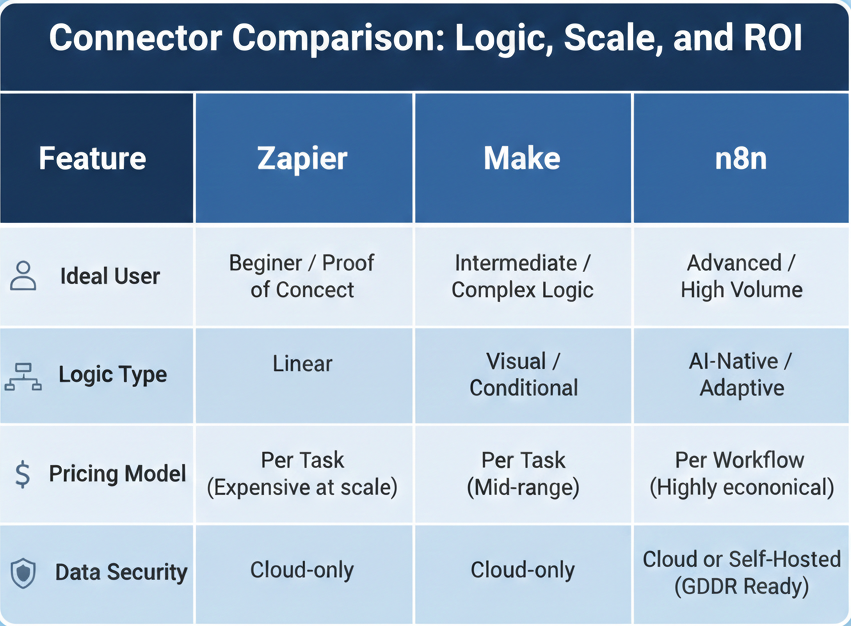
Which automation platform should I choose: Zapier, Make, or n8n? The ideal choice depends on your “Connector Progression Roadmap.” Zapier is best for beginners seeking simple, linear automations with a low learning curve. Make is superior for intermediate users needing complex conditional logic and visual process mapping. n8n is the premier choice for advanced users requiring high-volume processing, cost control through per-workflow pricing, and total data sovereignty via self-hosting.
1. The Strategy First Approach: Why Tools Follow Goals
Before diving into the technical specifications of each connector, we must anchor our decision to measurable business outcomes. As detailed in The AI-Driven Business, your AI stack is an investment in your company’s financial future.
Every automation you build should serve one of three pillars:
- Annual Revenue Targets (ART): Does the tool help scale personalized outreach or speed up sales?.
- Customer Lifetime Value (CLV): Does it facilitate proactive retention flows?.
- Cost Efficiency: Does it significantly reduce operational expenditure and human error?.
If a tool does not contribute to these pillars, it is merely another icon on your desktop.
2. Zapier: The “Proof of Concept” Gateway
Zapier is the most well-known connector in the market, often serving as the entry point for entrepreneurs following the The AI-Driven Business.
The Strengths
Zapier’s primary advantage is its simplicity. It offers the lowest learning curve, making it perfect for your first “Zero-Cost Quick Win”. If you need to instantly move a new lead from a Facebook form to your CRM, Zapier can do it in minutes.
The Scale & Budget Reality
While Zapier has a massive integration breadth, its free tier is restrictive regarding multi-step workflows. For high-value, low-volume tasks, the cost is manageable. However, at scale, Zapier becomes the most expensive option because it typically charges per task executed.
Is Zapier worth the cost for small businesses?
When is Zapier the right financial choice for a business? Zapier is financially viable for low-volume, high-value tasks where ease of setup is more critical than the cost per execution. It is the perfect starting point for entrepreneurs testing their first automation workflows before moving to more complex, cost-effective platforms as their volume increases.
3. Make (Integromat): The Logic Architect
As your business logic grows more complex, you will find yourself needing “conditional branching”—the ability to say “If A happens, do B, but if C happens, do D”.
The Visual Power
Make provides an excellent balance of power and visual clarity. Unlike Zapier’s linear list format, Make allows you to map out complex processes visually. This is essential for workflows like the Sale-to-Fulfillment Pipeline, where you might need to grant digital access, create a job ticket, and send a personalized welcome note simultaneously.
The Intermediate Budget
Make is often considered the “sweet spot” for entrepreneurs. It offers more power than Zapier at a significantly lower price point for complex logic.
4. n8n: The Industrial Powerhouse
For the strategic CEO, n8n represents the final stage of the Connector Progression Roadmap.
Achieving Scale and Control
The primary differentiator for n8n is its pricing model. Unlike its competitors, n8n offers per-workflow pricing rather than per-task pricing. If you are processing thousands of sales per month for a “Financial Control Tower,” n8n is the only choice that prevents your software costs from eating your margins.
Data Sovereignty and AI Integration
n8n is an AI-native environment that allows for self-hosting. This ensures full data sovereignty, which is critical for compliance with regulations like GDPR. It is also the superior desk for “Virtual Employees” or AI Agents that require access to multiple data sources to make autonomous decisions.
Why use n8n over Zapier or Make?
What are the main benefits of using n8n for business automation? The main benefits of n8n include significant cost savings at high transaction volumes due to per-workflow pricing, enhanced data security through self-hosting options, and a native environment optimized for managing complex AI Agents and multi-step autonomous workflows.
5. Comparative Analysis: Logic, Scale, and ROI
To make an informed decision, you must evaluate these tools against your current operational volume.
6. Implementation: Moving from Theory to Pipeline
Selecting the tool is only half the battle. You must then use the D.A.T.A. Framework to design the logic that powers it:
- Definition: Define the goal and the tools (e.g., Connect Typeform to Notion).
- Assumptions: State the required data fields (Email, Name, Source).
- Trigger & Logic: Outline the step-by-step IF/THEN path.
- Alerts & Errors: Specify human intervention points to prevent “set it and forget it” disasters.
By following this roadmap, you ensure that your automation infrastructure isn’t just a cost, but a scalable asset that pays for itself through massive time savings.
Conclusion: The Strategic Choice
The total infrastructure investment for a robust AI stack is often less than $120/month—equivalent to just a few hours of a virtual assistant’s time. Whether you start with Zapier for an “Instant Win” or graduate to n8n for “Industrial Scale,” the goal remains the same: reclaiming your 20 hours a week to focus on growth.